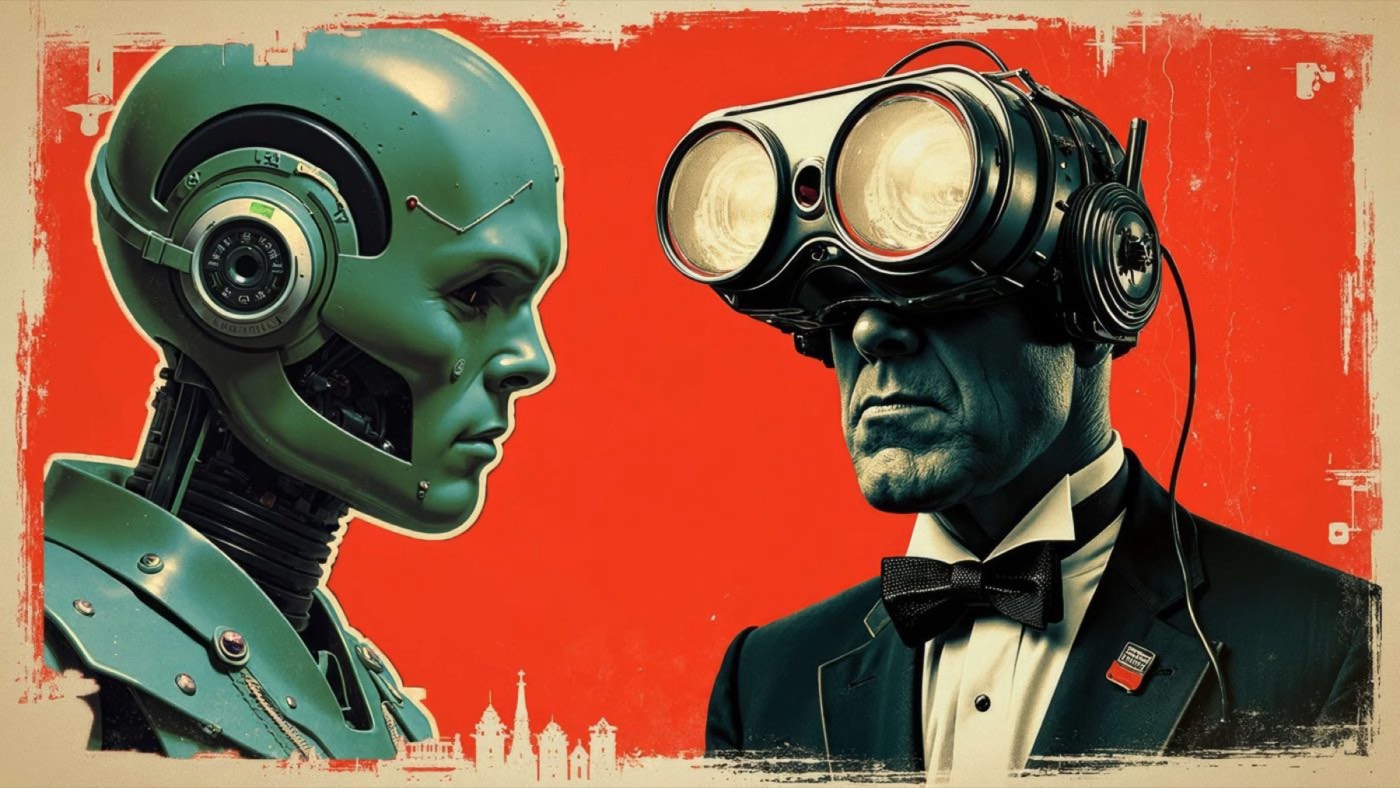
Breaking Free from the Spotify Mindset
Spotify is the biggest streaming service, not the whole market. How its money really moves, what its algorithm rewards, and where I put my music instead.
Talk to musicians for ten minutes and Spotify comes up. Monthly listeners quoted like a CV. Wrapped screenshots in every feed. Release plans built around one editorial playlist. Among friends and colleagues I hear Spotify discussed as if it were the music market itself.
It isn’t. It is the largest service, and that is a different thing. At the end of 2025 Spotify held 31.4% of the world’s music subscribers, according to MIDiA Research figures reported by Music Business Worldwide. Tencent Music, Apple Music, YouTube Music and Amazon Music share most of the rest. Big, yes. A monopoly, no.
The problem is not the company. It is the mindset: letting one platform decide how we measure our work, how we release it and what we think it is worth. I have released music, composed for film and dance, and worked with other artists on both sides of the glass. This is why I stopped thinking that way, and what I do instead.
How the money actually moves
Start with the number everyone shares: the per-stream rate. Tables of “what each platform pays per stream” circulate constantly, and an earlier version of this essay had one. I have taken it out. Those figures are averages that third parties back-calculate from royalty statements. They are not rates any platform publishes, and they vary by country, subscription type and the deal your music sits under.
Spotify does not pay a fixed amount per play. Its own Loud & Clear site explains the model: subscription and ad revenue go into a pool, and if your music accounts for roughly 1% of all streams, your rightsholders receive roughly 1% of that pool. The money goes to labels, distributors and publishers, who then pay artists according to their contracts.
At the top, that pool is large. Spotify says it paid out about $11 billion in 2025, and that more than 13,800 artists generated at least $100,000 on the platform that year, as Hypebot reported from the 2026 report. Those are royalties paid to rightsholders, not money in artists’ pockets. They also describe the top of a very steep curve.
At the bottom, there is a floor, and it is the policy I think every independent artist should know. Since April 2024, a track must reach at least 1,000 streams in the previous 12 months to generate recorded royalties on Spotify. Below that line the recording earns nothing; publishing royalties are still paid. Spotify presented this as a way to stop tiny payments from being lost in fees and to redirect the money to eligible tracks. That may be efficient. It also means a quiet experimental release, a field recording or a niche piece of contemporary music can be streamed hundreds of times a year and pay its performers nothing.
The same announcement introduced per-track charges to labels and distributors when flagrant artificial streaming is detected, and a two-minute minimum length for “functional noise” recordings to earn royalties. All three changes tell you how the system sees music: as volume in a pool, managed by thresholds.
Too much music, and not all of it made by people
The volume is the real story. Luminate counted an average of 106,000 new tracks uploaded to streaming services every day in 2025, and 253 million tracks on audio platforms by the end of the year. More than 120 million of them were streamed fewer than ten times in the whole year, according to Music Business Worldwide.
A growing share of that flood is not made by musicians at all. In July 2026 Deezer reported that fully AI-generated tracks had passed 50% of its daily deliveries on peak days in June, around 90,000 tracks a day. They account for only 1 to 3% of streams, and Deezer says up to 85% of the streams on those tracks in 2025 were fraudulent. In other words, much of this music is uploaded not to be heard but to farm royalties from a shared pool, the same pool real artists are paid from.
Spotify has moved too. In September 2025 it said it had removed more than 75 million “spammy” tracks over the previous twelve months, and it introduced a policy against unauthorised AI voice clones. Good. But it is a measure of the scale, not a solution to it. I wrote more about the fraud side in The Music Streaming Scam Epidemic and about rights in The AI Music Copyright Crisis.
What the algorithm rewards
When there is more music than anyone could ever hear, discovery is decided by recommendation systems. That is where the mindset does the most damage, because it teaches artists to make music for the system.
Look at how the system is designed. Spotify’s Discovery Mode lets artists and labels flag tracks for extra weight in personalised listening such as Radio and Autoplay. In exchange, Spotify takes a commission on the revenue from those streams, widely reported as 30% of recording royalties. Critics call it a modern form of payola. A subscriber’s class action making that argument was sent to individual arbitration by a New York federal judge in April 2026, as Music Business Worldwide reported, so the court never ruled on whether the practice is lawful. Spotify rejects the payola comparison. Whatever the legal answer, the incentive is plain: visibility is something you can pay for with your own royalties.
Then there are the playlists of background music. In a Harper’s investigation and in her book Mood Machine, both published at the turn of 2025, the journalist Liz Pelly documented Spotify’s “Perfect Fit Content” programme: stock-style tracks from production companies, released under invented artist names and placed in mood playlists, at lower cost to the platform. For a composer, the lesson is not about conspiracy. It is about function. A playlist built to sit behind your work or your sleep has no reason to tell you who made the music.
None of this is a reason to hate the platform. It is a reason not to let its metrics define what good music is. A track that holds the attention of two hundred people at a concert, or works for three minutes under a film scene, has done its job, even if the algorithm never notices it.
The label question
The old version of this essay was harsh on labels. I would put it more carefully now.
Distribution is no longer the bottleneck. Any artist can reach every streaming service through a digital distributor for a small fee. Recording at a professional level is possible with modest gear and real skills. So when a deal is offered, the useful question is not “is this legitimate?” but “what does this label do that I cannot do myself?”
Sometimes the answer is a lot: an A&R who improves the record, a team that can place it, a network, money for a proper studio. Sometimes it is an advance that will be recouped from royalties that, at streaming scale, may never arrive. Read the contract with that in mind. An advance is not a gift.
What I do instead
I have not left streaming, and I don’t advise others to. I treat it as a shop window, not as the business. The work that pays, and the relationships that last, happen elsewhere.
- Direct sales. Bandcamp is still the clearest example of a fair direct-to-fan model. Its standard revenue share is 15% on digital and 10% on physical, and on Bandcamp Fridays, when it waives its share, fans paid artists and labels about $19 million in 2025. In January 2026 Bandcamp also banned music generated wholly or substantially by AI. My own electronic work as Eric Oder lives on Bandcamp, and on this site I don’t send visitors to Spotify.
- Sync and commissions. Writing for film, dance, documentaries and brands is the core of my income as a composer, and it rewards craft rather than volume. I explain how licensing works in How Music Licensing Works.
- Live and physical. Concerts, performances and limited physical editions turn listeners into an audience. Fewer people, closer relationships.
- Teaching. Workshops and lessons pass on what you know, and they build a community around your work that no recommendation system can take away.
Technology is not the enemy
I use technology every day; I trained in electroacoustic composition, so the computer has always been an instrument for me. Machine learning already helps with tasks like cleaning up audio or separating stems, and I have no problem with that. What I reject is the idea that music is content to be produced at the lowest cost and in the highest quantity. That idea is what fills playlists with tracks nobody made and nobody chose.
- Spotify is the biggest service, just under a third of subscribers. It is not the market.
- It pays from a shared pool, not per stream. Per-stream tables are estimates, not rates.
- Below 1,000 streams a year, a track earns no recorded royalties on Spotify.
- Over 100,000 tracks are uploaded every day, and a growing share is AI-generated and used for fraud.
- Visibility can be bought with your own royalties. Don't let the algorithm define good music.
- Use streaming as a shop window. Build income through direct sales, commissions, live work and teaching.
The work outlasts the platform
Spotify will change its rules again; it has done so every year. Platforms rise and fall. What stays is the music you made with care and the people who chose to follow it.
So build where you own the relationship. Measure your work by what it does for the people who hear it, not by the count on a profile page. The platforms need music to exist. We should remember that the dependence runs both ways.